
For decades, we’ve planned our travels around the things under our feet: historic cities, sandy beaches, and towering mountains. But in recent years, a massive shift has taken place. Travelers are looking up. Welcome to the era of Celestial Travel—where the sky is the main attraction, and the destination serves as the theater.
At Go Arctic Trips, we believe the Nordics offer the greatest atmospheric shows on Earth. Whether you are hunting for ribbons of neon light in the dead of winter or seeking a sun that refuses to set in the height of summer, here is your guide to chasing the sky across the Far North.
The Winter Spectacle: The Aurora Borealis
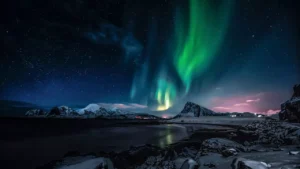
The Northern Lights remain the holy grail of celestial travel. But how you view them makes all the difference, and the Nordics offer wildly different experiences:
- Finland (The Comfort Approach): If you prefer your celestial viewing with a side of luxury, Finnish Lapland is unmatched. Home to the famous glass igloos, you can lie in a warm bed with a cup of hot berry juice and watch the sky dance overhead.
- Norway (The Rugged Safari): Tromsø is the undisputed capital of Aurora hunting. Positioned directly under the auroral oval, it offers some of the highest probabilities of seeing the lights. Here, celestial travel means strapping into a dog sled or joining an off-road safari to chase clear skies deep into the Arctic night.
- Sweden (The Micro-Climate Edge): Abisko National Park is home to the “Blue Hole,” a patch of sky over Lake Torneträsk that remains mysteriously clear regardless of surrounding weather patterns, making it one of the most reliable viewing spots on the planet.
Before you go, it helps to understand exactly what you are looking at. Explore the science behind the colors and shapes of the Northern Lights below:
Key insight: The color of the Aurora depends on the type of gas being struck by solar particles. Oxygen at lower altitudes creates the classic yellow-green, while high-altitude oxygen produces rare reds.
The Summer Phenomenon: The Midnight Sun
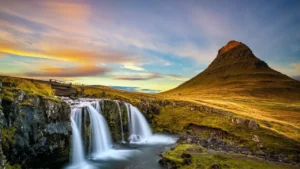
Celestial travel isn’t just for winter. In the summer, the Earth’s tilt exposes the Arctic to 24 hours of continuous daylight.
- Iceland: Summer in Iceland means the “golden hour” lasts all night long. Photographers flock here to capture the otherworldly landscapes bathed in a warm, low-angle glow at 2:00 AM. It’s an energizing phenomenon that allows you to explore waterfalls and black sand beaches completely crowd-free.
- Norway: Head to the North Cape—the northernmost point of mainland Europe—where you can stand on a sheer cliff face and watch the sun dip toward the horizon before immediately rising again.
The Dark Sky Sanctuaries: World-Class Stargazing
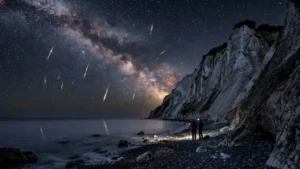
You don’t have to cross the Arctic Circle to experience celestial magic. Denmark is quietly becoming a premier destination for dark-sky enthusiasts. Islands like Møn and Nyord have been officially designated as Dark Sky Parks. With strict light pollution controls, these islands offer staggering views of the Milky Way and meteor showers, proving that sometimes the best way to see the universe is simply to find a place that is dark enough.
Ready to look up? Stop dreaming and start chasing. Contact Go Arctic Trips today to build your perfect celestial itinerary.
